Degenerative Myelopathy in Corgis: Signs, Testing and What Owners Can Do
Please see your vet. This guide is general education, not a diagnosis or treatment plan. If your corgi seems unwell, call your veterinarian. If it looks like an emergency, go to an emergency vet right away.
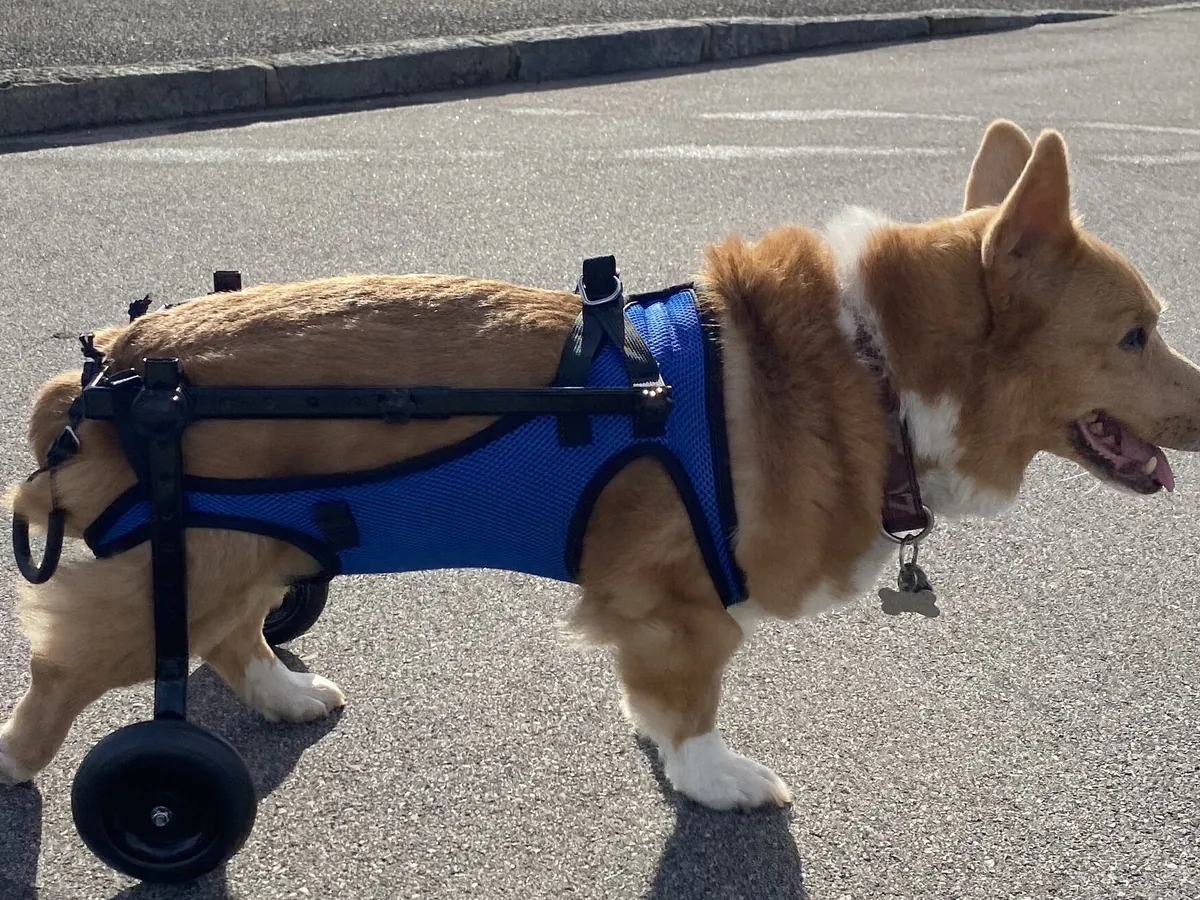
Photo: Frecker via Wikimedia Commons, CC0
Degenerative myelopathy (DM) is a progressive disease of the spinal cord that leads to hind-limb weakness and, eventually, paralysis. Early changes can look like ordinary aging or arthritis, so a veterinary exam matters whenever your corgi’s gait changes.
Your veterinarian — and often a veterinary neurologist — should evaluate new weakness. Many orthopedic and spinal problems share similar signs, and some of those problems are treatable. This article is general education, not a diagnosis or treatment plan.
What DM is, in plain English
According to VCA Animal Hospitals, DM is degeneration of the white matter of the spinal cord. The insulating myelin and the nerve fibers that carry signals to the limbs break down over time, so the hind legs gradually lose coordination and strength.
The American Kennel Club notes that DM is clinically compared to some forms of human amyotrophic lateral sclerosis (ALS). Most cases in dogs are linked to variants in the superoxide dismutase 1 (SOD1) gene, though other genetic and environmental factors also appear to influence whether disease develops.
Why Pembroke and Cardigan owners hear about DM
VCA lists both Pembroke Welsh Corgis and Cardigan Welsh Corgis among breeds identified as at risk, alongside German Shepherds and several others. The AKC likewise notes that DM seems more common in breeds such as Pembroke Welsh Corgis.
Clinical disease is still uncommon relative to how often the SOD1 risk genotype appears. A PWCCA summary by Jerold S. Bell, DVM cites a Veterinary Medical Database review in which about 0.6% of Pembroke Welsh Corgis were diagnosed with DM, and explains that most dogs that test SOD1 “at risk” never show clinical disease. We do not invent prevalence numbers beyond what those sources state.
Early signs owners notice
VCA and the AKC describe early signs that often include:
- Scraping or scuffing the hind toenails
- “Knuckling,” so the dog stands or walks on the top of a paw
- A sway or wobble in the hindquarters
- Falling more easily when nudged from the side
- Difficulty rising
- Gradual muscle loss over the thighs as mobility declines
DM is typically not painful. If your corgi cries out, arches the back or shows sudden severe pain, your vet will look for other causes, including intervertebral disc disease. Sudden paralysis, loss of bladder control or rapidly worsening weakness is an emergency.
Genetic testing: what a DNA result can and cannot say
Commercial tests for the common SOD1 mutation usually report three categories, as VCA outlines:
- Clear: two normal copies
- Carrier: one normal and one mutated copy
- At-risk (or higher risk): two mutated copies
Important limits, especially for Pembrokes:
- An at-risk genotype is not a clinical diagnosis. Imaging and a neurological workup are still needed to rule out disc disease, tumors and other look-alikes.
- The PWCCA explains that DM has a complex inheritance: dogs need more than the SOD1 genotype alone to become clinically affected. In that club summary, only about 1.1% of Pembrokes that test homozygous at-risk are expected to become clinically affected on average, and SOD1 results alone are a poor predictor of clinical disease.
- Because the mutation is so common in the breed, the PWCCA advises breeders not to make breeding decisions from SOD1 results alone unless there are pathologically confirmed DM cases in close relatives, to avoid needlessly shrinking the gene pool.
- Research published in PNAS found that variants in another gene, SP110, modify DM risk among Pembroke Welsh Corgis that are already homozygous for the SOD1 risk allele. The OFA offers a Pembroke-only risk-modifier test that is relevant only for dogs already SOD1 at-risk. Discuss whether that test is useful with your veterinarian or genetic counselor.
Cardigan owners should still use veterinary and parent-club guidance; VCA includes Cardigans on the at-risk breed list even though much of the published SP110 work focuses on Pembrokes.
Living with mobility loss
There is no proven medication that stops DM. VCA says physical therapy has been shown to slow progression, prolong quality of life and help preserve muscle mass, and that keeping dogs active and at a healthy weight matters. The AKC similarly highlights intensive physical therapy research and practical supports such as harnesses, booties, ramps and wheelchairs.
Home ideas that sources support as comfort and safety measures (always clear changes with your vet):
| Goal | Examples |
|---|---|
| Traction | Runners, rubber-backed rugs or mats on slick floors |
| Assisted walking | Rear-support sling or well-fitted harness |
| Paw protection | Booties if nails or knuckles scuff |
| Extended mobility | A custom-fitted canine cart, if your dog tolerates it |
| Healthy weight | Measured meals; extra pounds make weak legs work harder |
Keep a dated weight log in our weight journal and review body condition with your vet. Our healthy-weight guide covers the basics.
Questions for breeders and puppy buyers
Ask for health-testing paperwork on both parents and what the breeder knows about DM in close relatives. For Pembrokes, read the PWCCA DM explanation so you understand why an at-risk SOD1 result is common and why club guidance warns against eliminating carriers from the breeding population wholesale. Pair DNA paperwork with veterinary advice, not internet scare stories.
When to call the vet
See your veterinarian promptly for any new hind-end weakness, scuffing, knuckling or wobble. Seek emergency care for:
- Sudden inability to stand or walk
- Obvious spinal pain, crying or trembling
- Sudden loss of bladder or bowel control
- Weakness that worsens within hours or a day
Definitive confirmation of DM requires microscopic examination of the spinal cord after death, according to VCA, so living dogs are managed based on clinical findings and by ruling out other diseases. Your veterinary team can help you weigh rehab, mobility aids and quality-of-life decisions as the disease progresses.
Frequently asked questions
Is degenerative myelopathy painful for a corgi?
Most dogs with DM do not appear to be in pain, according to VCA Animal Hospitals; they are weak. The Pembroke Welsh Corgi Club of America likewise describes DM as a disease of lost motor and sensory function, not pain. If your corgi cries out or guards the back, ask your vet to look for other spinal problems such as disc disease.
Can degenerative myelopathy be cured?
There is currently no cure and no proven drug that reverses DM, according to both the American Kennel Club and VCA. Care focuses on keeping the dog comfortable and mobile for as long as possible with veterinary guidance, rehabilitation and home support.
Should I DNA test my corgi for DM?
A SOD1 DNA test can show clear, carrier or at-risk status, as VCA explains. For Pembroke Welsh Corgis, the PWCCA notes that many dogs test at-risk yet never develop clinical DM, so an at-risk result is risk information, not a diagnosis. Talk with your vet and, for breeding decisions, with club guidance before you act on a result alone.
What is the difference between DM and a slipped disc?
Intervertebral disc disease often causes sudden, painful spinal problems that may need emergency care. DM typically causes slow, progressive, non-painful hind-limb weakness over months. Only a veterinarian (often with imaging) can sort look-alike conditions; do not diagnose from a video or a DNA swab alone.
At what age does DM usually show up?
VCA describes DM as a disease of middle-aged to older dogs, with reported ages from about 4 to 14 years. The PWCCA says clinically affected dogs usually begin showing signs between 8 and 14 years, with an average onset around 11 years in Pembroke Welsh Corgis. Any new hind-end weakness still deserves a prompt vet visit.
A quick note: this guide is general information from published sources, written by dog lovers, not a veterinarian. Your own vet knows your dog's history, so check with them before changing food, exercise or treatment.
Sources
- VCA Animal Hospitals: Degenerative Myelopathy in Dogs
- AKC: Degenerative Myelopathy in Dogs
- Pembroke Welsh Corgi Club of America: Canine Degenerative Myelopathy and Genetic Testing in PWCs
- OFA: Degenerative Myelopathy Risk Modifier (SP110)
- Ivansson et al. (2016): Variants within SP110 modify risk of canine degenerative myelopathy (PMC)
Keep reading

Corgi Weight by Age: Pembroke vs Cardigan Size and Healthy Growth
How big do corgis get? Adult weight ranges from the AKC breed standards for Pembroke and Cardigan Welsh Corgis, plus how to track a puppy's growth with your vet instead of chasing a monthly weight chart.


Corgi Obesity: How to Keep a Food-Loving Corgi at a Healthy Weight
Keep a corgi at a healthy weight with vet-backed body-condition checks, measured meals, a treat budget and gentle daily movement that protects joints.